Tracking my efforts to beat Myalgic Encephalomyelitis (ME), aka CFIDS, aka CFS

Tracking my efforts to beat Myalgic Encephalomyelitis (ME), aka CFIDS, aka CFS

Monday, January 14, 2013

Book Review: The Paleo Solution, by Robb Wolf

I've added this book review to my ongoing list of ME/CFS-related book reviews.  For the full book review page, click here.  


I had already been on a Peleo diet for about a year and a half when I started this book, but sometimes I just like to 'reaffirm my faith.'  Keeping such a strict diet requires a fair amount of willpower, so I find that it's good to remind myself of why I'm doing it in the first place.  The Paleo Solution did that and even taught me a few things I didn't already know.  

Drawbacks:  If you read the 1 star Amazon reviews of this book, almost none of them mention the diet itself.  They all seem to focus on Wolf's writing style, which can be annoying at first.  Wolf is really excited about paleo.  I mean, really excited.  And he wants everyone to know it.  So his writing style comes off as a little bit pushy and sales-y, like an infomercial.  To him, every reader is a whining, reluctant wimp who needs tough love.  Wolf likes to address you as "Buttercup" before he gives you some no-nonsense straight talk.  

But the writing style ceased to bother me after the first couple of chapters.  We all know people with quirky personalities.  After a time, I sort of adjusted to Wolf's idosyncrasies and accepted that "it's just Robb being Robb."  For me, it happened by Chapter 3.  But this is, of course, subjective.  A minority of people just won't be able to get past the style.

The only major substantive failure was that the book failed to explain why dairy should be minimized or avoided.  While Wolf makes the case against sugar and grains like a dogged prosecutor, dairy was hardly mentioned except to say that it should be avoided.  As someone who's on the fence about dairy and still eating/drinking it occasionally, I would have liked more informationmore scientific data, as in the grains sectionto make up my own mind.  

Pluses:  For a book with such a quirky style, the scientific content can seem out of place.  By Chapter 3, Wolf delves heavily into the scientific underpinnings of the Paleo diet.  This is the good stuff.  I've read much of this information before, but Wolf explained it in layman's terms perhaps better than anyone else. He makes a very convincing case.  Just like I did with Life Without Bread, I'm now trying to convince my loved ones to read this book because I want them to get it.  

The longest chapter in the book is on exercise.  Most PWMEs will want to skip that chapter since any real exercise, in conventional terms, is pretty much out of the question.  I read the exercise chapter anyway just for the information about the daily lives of cavemenalways fascinating to me.  

The second to last chapter contains several dozen paleo recipes as part of a proposed 30-day meal plan, including paleo pancakes and paleo pizza.  I suspect most people won't follow the 30-day meal plan day-by-day, but rather, will pick and choose a few of the best recipes.  Finally, the last chapter has some great information about supplements, like recommended doses, brands, and the importance of them.  This should be a popular chapter with PWME's.  I learned a few things about DHA/EPA ratios and the importance of quality in Omega-3 supplements.

It's fairly brain-fog friendly book and, at the same time, loaded with facts that will convince you (or reaffirm your faith) that paleo is the only way to go and rest of the world needs to get on board or continue slowly killing themselves.  (★★★½)

[5/30/13 edit:  The paleo pancake recipe is absolutely incredible.  I think they taste better than regular pancakes, and others who are NOT on paleo diets have agreed.  It's worth the price of the book just for that one recipe alone.  We now eat paleo pancakes about once a week for dinner.]

Friday, January 11, 2013

Video Interview with Dr. Chia - A Must-Watch

Below is a two part interview of Dr. John Chia where he discusses the causes of ME/CFS and his recommendations for its treatment.  I may be biased, as Dr. Chia is my treating physician, but I strongly believe that every PWME and their friends/loved ones should watch these videos.

The interviewer is journalist Lewellyn King of PBS fame.  King has taken an interest in CFS in recent years, as seen in these interviews and on his website.  (King's article "Chronic Fatigue Syndrome and Its Chronic Costs," linked above, is also worth reading.)

You may wish to watch a larger version of these videos by clicking the YouTube symbol in the lower right corner of the screen and watching the videos directly from YouTube.  


PART 1


                                                                            PART 2


Thursday, January 10, 2013

A flaw in my diet plan: Almonds

I've been on a low carb, Paleo-like diet for over a year.  (I say Paleo-like because I eat modest amounts of dairy from time to time.)  There's no question that the diet has helped me improve, especially my gut symptoms.  "Nausea and gut disturbances" used to be a category on my daily health chart, but I was able to eliminate that category about 3 months after switching to a low carb diet.  I don't experience gut issues any longer unless I break from the diet.  

But since changing to a low carb diet, almonds have been a major staple in my diet.  I toss those suckers back by the handful; I drink almond milk dailyall because I read somewhere that almonds are one of the few nuts that are compatible with an anti-Candida diet.  (My blood tests continue to show high Candida antibodies.)  

On the other hand, an anti-inflammatory diet is important for PWMEs.  It is thought that inflammation is one of the causes of many of our symptoms in ME/CFS,[1][2] and it seems that the low carb diet crowd keeps growing and growing in ME/CFS circles.  God knows, it has helped me.

Now, one of the keys to an anti-inflammatory diet is maintaining a low ratio of Omega 6's to Omega 3's.  Omega 6's are pro-inflammatory fatty acids, while Omega 3's are anti-inflammatory fatty acids.  Omega 6's are much more common in our foods, so it's difficult to achieve a 1-to-1 ratio of 6's to 3's, but a reasonable goal is about 3-to-1 or 2-to-1.

So as I was reading tips to lower one's Omega 6/3 ratio, I came across this tidbit from whfoods.com:

"So, how can you go about lowering your 6:3 ratio? One excellent approach is to [eliminate] foods in your diet that are relatively high in omega-6s and low in omega-3s. 
For an example, let's take almonds. With no omega-3s and about 4-5 grams of omega-6s per cup, your almonds are a member of the nut family with the highest possible 6:3 ratio. Once you've located a food like almonds with a very high 6:3 ratio, look inside of that same food group (in this case nuts) for a food with the most possible omega-3s. In this case, walnuts would make an outstanding choice within the nut group because walnuts have about 2.25 grams of omega-3s per quarter cup and a 6:3 ratio of about 4:1. Just by replacing almonds with walnuts, you could make an important shift in your 6:3 ratio."
I checked the accuracy of this ^ statement against other sources and it appears to be true.  Many other sources warn against the pro-inflammatory qualities of almonds.  It's just a little vexing to know that I may have been cancelling out some of the benefits of my diet for the last year.  On the other hand, I suppose it's encouraging that I might reap even more benefits from my diet by making one simple elimination.

Now, the challenge is to find a replacement for all those nutty almond calories.  Walnuts?  We'll see...

Monday, January 7, 2013

Article: What PWME's Want Well People to Know

Thanks to Sue Jackson and her excellent blog for bringing this article to our attention.  I'm going to repost it here because it's a great summary of the frustrations that we face in dealing with some well people.  My only criticism of the article is that it paints with too broad of a brush and doesn't do enough to acknowledge that there are many well people who do get it.  


Sunday, January 6, 2013

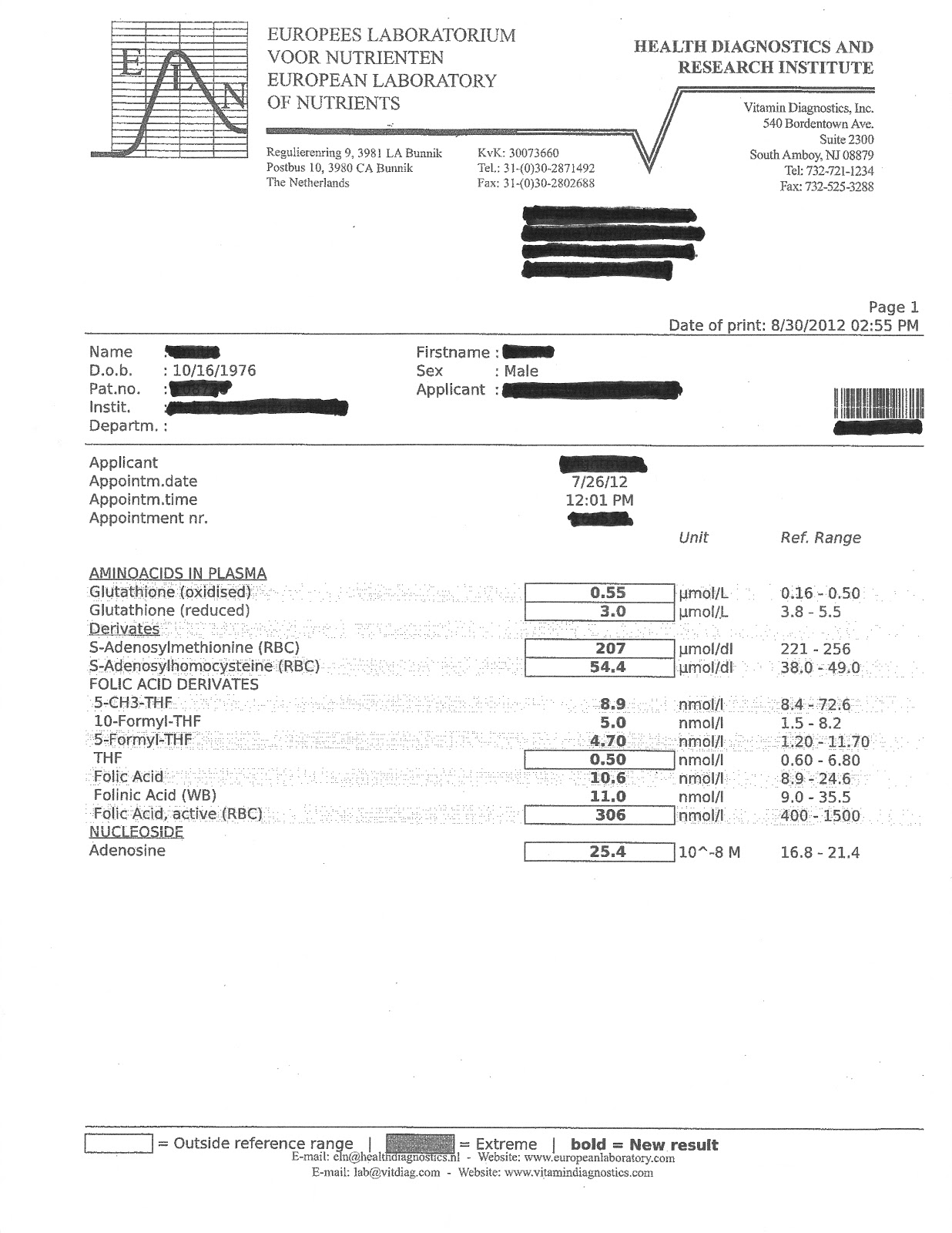
My Methylation Panel Results

I finally received the results of my Methylation Panel blood test results.  This test measures the function of a person's methylation cycle: the body's biochemical pathway that is responsible for detoxification, immune function, maintaining DNA, energy production, and many other critical functions.  All of this occurs at a cellular level.

Increasingly, the function of the methylation cycle is being considered as one of the candidates for the biomarker of ME/CFS.  So far, nearly every PWME who has reported their results on Phoenix Rising has apparently shown a defective methylation cycle, whereas a control group will not show any abnormalities.

The only lab in the United States (at least that I am aware of) that performs this blood test is Vitamin Diagnostics in New Jersey.  I obtained a doctor's order back in March, then ordered the test tube kit to be shipped to me by Vitamin Diagnostics.  From there, I had to find a lab that would draw the blood and ship it to New Jersey, which I finally did in July, 2012.  Now, I've finally received the results almost a year after the process began!

The results are very consistent with other PWME's on PR who have taken the same test.  There is no doubt about it, my methylation cycle is broken.

The next step is to get back on a methylation protocol.  I was on Fredd's Active B12 protocol for most of 2012, but I didn't notice much of a difference while I was on it.  So I think I'm going to switch to the late Rich Van Konyenberg's Simplified Methylation Protocol.  Maybe I will run this test again in another year and see if my numbers improve.

[3/5/13 edit:  Before I had a chance to start the Simplified Methylation Protocol I read Dr. Amy Yasko's book so now I'm going to do the full, un-simplified protocol.  I'm convinced this might be necessary for me.]

My results are posted below.  All numbers in a box are outside of the reference range--i.e. abnormal.  My main conclusion  comes from the first two numbers.  The too-high Glutathione (oxidized) means that my body is suffering from oxidative stress -- it simply cannot eliminate oxidized glutathione efficiently.  This is why, I believe, even small amounts of exercise exacerbate my symptoms.

The second number (Glutathione - reduced) means that I am not producing enough glutathione, which simply indicates that the methylation cycle is broken.

For a full article on how to interpret these results, see Rich VanK's article on Phoenix Rising.

Thursday, January 3, 2013

My Daily Health Chart

Since I'm always interested in exchanging ideas and tip for managing this illness, I thought I'd share my daily chart.  It's my understanding that many of us track our daily progress in one form or another.  I've spoken with several other PWME's who keep similar charts.  Without it, it's hard to gauge which treatments may be helping, and which activities may cause crashes.

I'm always interested in improving my chart and sharing ideas, so I hope this will generate a discussion or exchange of ideas.

Before I post the link to my chart, a few notes:

This is not my actual chart, but a replica with the same format and categories.  The 5 day's worth of health information is just made up.  While I don't mind sharing most of my ME/CFS journey with the general public on this blog, I have to draw the line at this greater level of detail.

Google Documents:  When I first started, I kept a chart locally on my computer.  Around June of last year, someone recommended that I use Google Documents' spreadsheet format.  (I think it was Grayson or Baffled?)  I soon switched to Google Documents and never looked back.  I can now access my chart from any computer.  I don't have to take anything with me if I leave the house for a few days...as long as I'll have access to a computer.  I can also provide a link to my family and they can access it from their computer.

The spreadsheet format also allows me to create instant graphs from any two or more of my columns.  So, for instance, I can highlight the column rating my overall daily score, and the column rating my daily physical activity.  (I measure both on a scale of 1 to 10).  The program then instantly creates a graph that allows me to visually spot patterns and relationships between the two types of data.  This helps me see trends and causal relationships that I wouldn't have ordinarily noticed.  I can try to pinpoint where my crash threshold is.

Because of the graphing capabilities of the Google spreadsheet, I try to use numerical values, not words, whenever possible.  For instance, under the column "Work Day?", instead of writing a Y or N, for Yes or No, I use 1s and 0s.  This allows me to create a graph and observe, visually, how work impacts my overall daily health rating (not so far).

I'd love to hear what tips and tricks others have picked up.  My sample chart is linked below:

https://docs.google.com/spreadsheet/ccc?key=0AiPMEG7bO4TNdHpwQzdGbzNkR3JUcklqTzdnYzRNTHc

Tuesday, January 1, 2013

Update to last night's post

I did, indeed, spend midnight of New Year's Eve in the emergency room.  In fact, exactly at the stroke of midnight, I was getting blood drawn from my right  wrist.  I remarked to my phlebotomist that the clock had just struck midnight but he didn't seem to care.  Just another night in the ER I suppose.  At least I'm not likely to forget where I spent NYE 2013.

Anyway, the ER doctor thinks my extreme shortness of breath was "probably" due to the Epivir.  My blood oxygen level measured low--although not so low as to require intubation.  He told me to stop taking the Epivir immediately and see if my situation stabilized.  So far, today, I do feel slightly better.

As always, thank you for reading.  And happy new year.