Tracking my efforts to beat Myalgic Encephalomyelitis (ME), aka CFIDS, aka CFS

Tracking my efforts to beat Myalgic Encephalomyelitis (ME), aka CFIDS, aka CFS

Friday, December 20, 2013

My experience with acupuncture as a treatment for ME/CFS

I've been interested in acupuncture as a possible treatment for ME/CFS for about a year and half—ever since reading an article linked in my prior blog post about acupuncture being a potential Th1 immune booster.  Nobody would expect acupuncture to cure them of ME/CFS, but I figured it was possible that acupuncture could provide marginal improvements in immunity and energy and potentially halt a crash. But every time I wanted to try it in the past, there was always another treatment that seemed like a higher priority.  Then last week I started to feel a mini-crash coming on so I finally scheduled an appointment with a local acupuncturist.

Expectations

One the one hand, I've known at least two other PWMEs who tried acupuncture and neither of them stuck with it.  The first said she felt only a tiny bit better after each session, but it wasn't enough to continue paying for such an expensive treatment (usually not covered by insurance).  The second actually reported that acupuncture made her worse, and that it brought on an insatiable hunger.

On the other hand, there was the article linked above (which admittedly only dealt with electro-acupuncture... on mice).  So I had two anecdotal stories and a vague article about a study on mice.  I would just have to try it myself to know for sure.  For science!

Finding an Acupuncturist

I was determined to hire the best acupuncturist in my area, so I took to the internet and Yelp until I was satisfied that I had found the best.  Frankly, I really wanted my acupuncturist to be Asian, trained in Asia, since acupuncture is a Chinese art/science.  The person I identified as "the best" was actually Japanese (not Chinese) but somehow I felt that that was better than a random Caucasian.  She had a very quintessential Japanese female name.  I'll call her Midori.*

Preparation

Midori's office is in the same medical building as my GP.  I arrived 15 minutes early to fill out all the usual paperwork as with any first doctor appointment.  Of the 10 or 12 boxes that I could check as "reasons for your visit," the top was Chronic Fatigue Syndrome.  (They weren't alphabetized)  Another choice said, "Immunity."  I took this as a good sign.   

The receptionist determined that my insurance would cover $30 of the $85 fee, so I settled up the difference and was the lead to a room that was a cross between a doctor's exam room and a day spa massage room.  Actually it was more like an exam room in most respects, except it had a massage table instead of an exam table, and the room was filled with the sounds of some dreamy new age music ala a day spa.

Midori came in shortly after and asked me a series of health-related questions for about 10 minutes. What's your diet like?  Do you eat fish regularly? Do you exercise?  Her Japanese-American accent was quite thick, so we had to repeat things for each other occasionally to make sure there were no unfortunate misunderstandings.  Annoyingly, she referred to my condition several times as simply "chronic fatigue" and asked if I "just want more energy."  I gently refocused the discussion to my immune system deficiencies and emphasized immune boosting and inflammation reduction as the goal of treatment. She seemed to understand.  She said that I should drink at least one glass of water with lemon in it each day—that this is good for my liver, which in turn is good for immunity.

At the end of this interview, Midori said that she would focus on total body circulation and flow of qi (pronounced 'chi'), both of which are good for immunity.  

"Tons of Needle All Over" Me

Unlike a massage, there is apparently no removing of the pants in acupuncture.  I learned this only after removing my pants and being instructed to put them back on.  I only had to remove my shirt and roll up my pant legs to the calves and I was good to go.  I laid face down on the table first. Midori pinched and poked me on my neck and my ankles, perhaps taking stock of my qi.  She said that the needles are thinner than the width of a human hair and that I wouldn't feel much at all.

As I lay with my face in the massage table's padded face-hole, Midori inserted two needles into the back of my neck.  She was right, I hardly felt a thing.  I had to take her word for it that there were, in fact, needles in me.  Four or five more needles were inserted into my back, and two more in each foot/ankle area.  

Midori said in an easy, sleepy tone, "there are now tons of needles all over your body. I  will come back in ten minutes."  

In ten minutes, Midori came back and removed all the back needles and instructed me to turn over onto my back. This time, she put the needles in my hands, arms, chest, and feet, culminating with a single needle at the very top of my head.  Again she said the thing about "tons of needles." I smiled at the mental image.  And then she left the room again for another ten minutes.

This time I had a chance to look at the needles.  Unlike in pictures and TV, the needles didn't stick straight out into the air.  They hung curled over and limp from their insertion points.  

I tried to determine if I felt any different, but Midori had placed a portable heat lamp over me so it was impossible to tell whether I was feeling the mysterious qi or just a GE lightbulb.  I felt like I was a fast food meal.  

Midori soon reentered the room, removed the needles and told me to put the rest of my clothes back on. Back in the reception area she told me that I needed more work and that she'd like to see me next week.  I said I'd think about it.  Her parting advice was to drink plenty of water to flush out my system now that all the toxins had been dislodged into circulation.

The After Effects

As I walked out of the building and toward my car, I assessed how I felt. Quite frankly, I felt that the whole experience was a "poor man's" massage.  I felt the familiar boost of calming energy that one gets after a professional massage, but only about 50-75% of it.  I could tell that my circulation was better and my head was clearer, but again, I couldn't help feeling that it wasn't quite as effective as a one-hour Swedish.  And just as after a massage, I felt intense thirst.  I'm convinced that both massage and acupuncture work in similar ways—that somehow improved circulation is the point of both, and that both lead to unquenchable thirst.  In different degrees. 

I also noticed that the glands in my neck felt swollen, whereas they weren't before the treatment.  As the day went on, this evolved into the tongue swelling that I often get when my glands get particularly swollen.  I felt that the treatment may have stimulated my immune system, but perhaps stimulated the wrong side of it.  This felt more like Th2 activation than Th1.

Now, two days post-treatment, I haven't noticed much positive improvement.  If anything, the treatment had more undesirable affects (gland swelling) than benefits (slight increase in energy on the day of treatment.)  I'm glad I tried it and satisfied my curiosity, but I don't think I'll be patronizing acupuncture again.  My sense from Yelp reviews is that acupuncture works better for people who have pain issues. In the future, if I feel like I really need to part with $85, I'll get a massage instead.


*not her real name

Thursday, December 19, 2013

What fills me with inexplicable rage (ME/CFS related)

Before ME/CFS, there were only two things that filled me with irrational anger and irritability: The first was any scraping of a metal bowl (such as from a mixer) with a metal spoon. Metal on metal....I just hate it.

The second was someone chewing cereal or an apple loudly, especially with their mouth open.

Now thanks to ME, I have a third one, and it's when people have sneezing or coughing fits. I just want to yell at them, "Get ahold of yourself, Typhoid Mary!"

I'm trying so hard to not let my anger at my nice coworker show, but I'm afraid she knows I loathe her right now.  You should see her -- she looks like she just wrestled a bear in the arctic; hair all a-mess and nose as red as a wino's.  Why is she here?

It's bad enough to expose fully healthy co-workers to your germ-y hands and foul air, but to do it to immuno-compromised people?  That's beyond the pale.  And I don't mean to just pick on her -- there are a ton of people walking around in public this time of year like the goddamn walking dead.  *Sigh* I shouldn't be too hard on her, she's a good person just trying to make a living for her family.  The point is more about me -- the changes that ME/CFS has brought over me and my outlook on certain things.     

(Side note: I had to add the "ME/CFS related" parenthetical to my title because I know from past experience that if my title is not ME/CFS related, I start getting unwelcome visits from all over the internet.  And let's just say I don't want to meet the people who search "inexplicable rage.")

Tuesday, December 17, 2013

Some pretty big news from Dr. C

I had my latest appointment with Dr. C last Friday.  One of the great things about Dr. C is that he never limits our discussion to my personal struggle with ME/CFS.  He always broadens the discussion into the latest developments in ME/CFS research.  I never have to initiate this broader discussion—he brings it up on his own.  Since I assume he does this with all patients, one wonders how he doesn't drive himself insane having the same conversation with patients after patient all day long.  I can only assume that he recognizes how starved we as patients are for the latest research news and takes pity on us.  He never makes these discussions feel rushed—it's always as if we're sitting in a coffee shop chatting as friends.

                                                                     Dr. Lipkin's Findings

The discussion started with the major findings of Dr. Ian Lipkin that made headlines back in September. (Here's a link to a Phoenix Rising article about those findings.)  Dr. C always has always heaped effusive priase for the work of his fellow ME/CFS researchers, as he did with Dr. Lipkin.  Dr. C pointed out, however, that many people have misunderstood the significance of Lipkin's research, believing that a viral cause has all but been ruled out.  To put Lipkin's research into better context, Dr. C pointed out that not only was Lipkin's virus hunt limited to the blood, it was limited to blood plasma.  Dr. Lipkin did not look for viruses in the white blood cells of ME/CFS patients, which is a better place to look for possible ME/CFS-causing viruses in the blood, according to Dr. C.

When Dr. C did his own virus hunt in the blood of ME/CFS patients years ago, he found enteroviruses in approximately 60% of patients' white blood cells, as opposed to only 2 in 20 in the plasma.  Admittedly, he used a small sample size.

As many people know, Dr. C firmly believes that the place to hunt for any viral cause of ME/CFS (which he postulates is a enteroviruses) is in the body's tissues.  Dr. C has always focused on biopsies of the gut, partly because the gut is the easiest internal organ from which to obtain a biopsy.

Getting back to Dr. Lipkin for a moment, Dr. C noted that Lipkin's next big endeavor is to look for evidence of viral infection in the stool samples of ME/CFS  patients.  According to Dr. C however, this is not likely to be fruitful.  If looking for viruses in the blood is like looking for a needle in a haystack, looking for viruses in stool samples is like looking for a needle in a haystack that is 10x as large.  (He said all this while heaping praise on Dr. Lipkin, so while it is clear that while Dr. C prefers to pursue other theories, the has the utmost respect for Dr. Lipkin.)  At the same time he said, "I certainly have a number of questions for him [Dr. Lipkin] at the March conference"—referring to the upcoming IACSF/ME conference in San Francisco.

Finally, Dr. C also mentioned that Lipkin's next big treatment experiment will be with cytokine blocking drugs, noting that some of Lipkin's recent research has confirmed the "cytokine storm" that many of us believe is a cause of our rampant inflammation.  Without sounding too contrarian, Dr. C again stated that he would be hesitant about recommending cytokine treatment to any of his other patients until further research.

He gave the example of one of his patients who had terrible neck stiffness due to a cytokine storm concentrated in that area.  This patient was treated with an experimental cytokine blocking medicine by another doctor, and two months into the treatment the patient began to have terrible neurological problems, including major involuntary spasms all over his body and the gradual loss of all speech. The patient can only speak now through a computer, ala Steven Hawking.  Dr. C is now attempting to help recover the young man's speech through IVIG treatment.  I asked if Dr. C thought these symptoms were side affects of the cytokine blocking drug and he said, "we think so."

New Antiviral Drugs

Dr. C has long discussed the possibly that certain antiviral drugs "in the pipeline" would help treat ME/CFS.  He states that any new antiviral drug gives hope to our community.  In January, 2014, a drug company is expected to launch a new Hepatitis C antiviral drug that Dr. C plans to test on ME/CFS patients. The drug apparently costs, not joke, about $30,000 per month!  No word on how or by whom this experiment would be paid for.

Later in 2014, two other drug companies are expected to drop competing Hep C antivirals.  This should introduce competition in to the market and hopefully give ME/CFS patients two additional chances to find an effective antiviral.  

Other than those three impending Hep C drugs, Dr. C said there is no other "chatter" about additional antiviral drugs in the pipeline. But he noted that this lack of chatter may be because drug companies like to keep such projects secret for fear of being ripped off and beat to the marketplace by competitors.  

                                                                Dr. C's New Findings

Not to bury the lead but.... Dr. C says that he obtained tissues samples from a recent patient of his who, tragically, committed suicide.  The family was kind enough to donate the body to Dr. C's research. (Side note: I'm trying to walk a fine line here because Dr. C states that his findings will be announced at the March IACFS conference and not before then, so I don't want to steal his thunder).  All I can reveal at this point is that Dr. C found a raging enterovirus infection all throughout a major, very critical organ from this deceased patient's body.  (I'm sorry, I can't reveal the organ).  Dr. C is certain that it is the same enterovirus he has been finding in the linings of the guts of his patients for years.  (Although, he noted that this enterovirus was detected by the protein that it produces, not directly by sequencing the virus, which is very expensive.  When and if he ever obtains the funds, he would like to sequence the virus from his organ sample and conclusively prove that it is the same enterovirus from the gut.)

My Revised Game Plan

To quickly summarize my past work with Dr. C: I had success and continue to have success with his oxymatrine treatment called by the brand name Equilibrant.  This helped me improve by about 10%.  But none of Dr. C's additional pharmacological treatments did anything for me, and some had bad side affects.  I've tried Rifampin, Epivir, Amantadine, and inosine among others.

After some discussion, we decided to revisit some of the failed treatments to confirm that the side affects I thought I experienced were truly from the drugs and not from, say, a crash.  So the plan is to, in addition to continuing Equilibrant, take both inosine and Epivir together in combination.  We'll see if that makes a difference this time.

Possible Sad News

Toward the end of the appointment, in the context of another discussion, Dr. C stated that he would like to move on to other areas of research besides ME/CFS.  Then he asked rhetorically, "but then who would take care of my patients? You see, for diseases like HIV where the treatment routine is so well established and understood, a nurse practitioner can be a patient's sole medical provider.  But with this disease, my patients need me to treat them individually."  So it was unclear if Dr. C would actually move on from ME/CFS, or if he was simply expressing the desire to.  

I told him that we need him and that he is practically a celebrity in certain circles and why give that up? I'm not sure it helped... 

Tuesday, December 3, 2013

A quick follow-up to my groin pain post

I've now been taking Cipro since last Wednesday night (12 doses out of a total of 20) and I still have the pain.  Oddly, there was a  reprieve on Sunday, when I felt almost no pain all day, and then it came right back on Monday.  I have been very good about taking Cipro apart from other supplements and food containing minerals, to ensure absorption.  The D-Mannose has not helped either.

I now believe that the issue probably is not bacterial.

I have a return appointment with the urologist on Monday, at which point I will explore other possibilities with him.  I posted about this issue on an ME/CFS forum recently and got a surprising number of good suggestions and possibilities.  One possibility I wonder about is if it could be candida in the UT, due to deficient immunity.  I may try a few days of Diflucan and see if that helps.

Thanks to everyone who has given me feedback and advice on this since my last post. We truly have a knowledgeable and compassionate community that (for the most part) works together to help one another.

P.S.  I am aware of the significant risks that Cipro poses, and believe me, I did not take them lightly.  I accepted the risk and unfortunately it did not pay off.  I thank those who raised the issue nonetheless.

Saturday, November 30, 2013

What a pain in the d***

Two major things have been going on in my life since I last blogged (which feels like a year ago to me.) About 4 or 5 weeks ago, I began packing for my big move (to a nearby city).  Around the same time, I started getting pain in my groin, just like the last time I packed and moved in 2005.  (Stop reading here if you're uncomfortable with frank discussions of male anatomy).  This pain persisted for about three weeks until I finally visited a urologist.  He determined that I must have prostatitis, the male version of a urinary tract infection (UTI), and prescribed oral antibiotics (Doxycycline).

I started taking Doxy a few days before moving day and, with huge relief, it cleared up the pain just in time for moving day.  Moving day went off without a hitch (more on that later), and I was pain free all day.

But then the pain came right back a couple of days later, worse than ever.

Worried now that I might have an infection that was too strong for Doxy, I called the urologist and he switched me to a stronger antibiotic, Cipro.  What worries me at the moment is that I've been on the Cirpo (2x day) since Wednesday night (7 doses) and the pain still persists!

I'm wondering now if this isn't a bacterial infection at all.  Before I visited the urologist, I took a few home UTI tests by AZO and they were all negative for infection.  The urologist also had me give a urine sample, but he never reported the results to me and I forgot to ask.  I note that he only proclaimed that I had prostatitis after listening to me describe my symptoms, so I can only conclude he diagnosed me clinically, not by urine sample results.

In the meantime, I have also been taking D-Mannose powder, which came strongly recommended to me by a few message board ME/CFS friends who have dealt with chronic UTIs (part of the fun of having a weak immune system, I suppose.)  So I have also been taking D-Mannose twice per day since Wednesday with no benefit yet.

I suspect this will be an ongoing issue for some time...

Let me tell you, I never thought I'd be discussing my private parts on the internet, but now that I am, it's really not too scary.  We're all adults here, right?

Right....?  [I'm not so sure about myself]

                                                     ______________________

One of the good things to come out of this is that the lymph nodes in my neck and armpit have stopped feeling swollen.  I know that some PWMEs deal with lymph node swelling every single day, but for me, I only started to experience serious, every-day swelling starting about 6 weeks ago, before the groin pain.  (I thought they might be connected, but the urologist said that was impossible.)

Anyway, the antibiotics have put a stop to that daily discomfort for now, suggesting I was dealing with a chronic, low-level bacterial infection somewhere in my body.  I have no idea where.  Top suspects are the lungs, sinuses and/or throat.

                                                      _____________________

The move:

Leading up to the day of the move, I had one wish: that I would not be crashed on the day of the move.  I got that wish.  Even though I had very poor sleep the two nights before the move, I woke up the day of the move with decent health (relative to my baseline*) and adrenaline carried me for the next 10 hours or so.  It was by far the most active I've been since getting ME/CFS.  It was enough activity that I would have been exhausted at the end of the day even before ME/CFS.

I remember finally laying down in bed that night (in a strange new bedroom) and thinking, "With a day like that, I'm due for a big crash."

That crash never came, and the move was just over a week ago.  While I certainly did experience some PEM a day or two after the move, nothing could be described as a crash.

Since then I have been calling contractors and repairmen of all types trying to get this new house in order.  Many of my calls were for tasks that I would have tackled myself prior to ME/CFS.  But this is my new reality and I'm slowly getting used to it.

This new house (which I truly love) is not a low-maintenance house by any means. Which suggests it's not ideal for a PWME.  And I'm OK with that.  The house is old (by California standards) and it's got character and charm, but with that comes maintenance.  Much of this maintenance I hope to do myself, with only proper pacing of course.

I have a running mental list of about 60 or 70 projects, both large and small, that I want to undertake to get this house into the shape I want it.  My instinct tell me to attack them all at once.  The old me would have worked from dawn until dusk over this long holiday weekend until I completed as many tasks as possible each day.

My new reality means pacing and patience, something that is extremely difficult for me.  Nevertheless, I am slowly beginning to accept that (a) I don't have to do everything myself, and (b) it doesn't all have to get done as soon as humanly possible.

I'm learning that I can enjoy the charms of this house even if it isn't set up exactly the way I want it...yet.  And I also realize that I won't enjoy the charms of this house as much if I'm laid up from a nasty crash.

                                                          ______________________

For those that gave me advice and support in the comments section of my prior post related to the move, thank you!  I truly appreciate everything.

Tuesday, October 22, 2013

Taking Risks In Life: Harder with ME/CFS

First, this is the longest I've gone between blog posts, but I've always promised myself that I would not blog just to blog -- that I would only blog when I had something I felt needed to be said.
                                                                  ____________________

August and September were by far my best months since getting ME/CFS.  They both averaged at least 3 percentage points higher on my daily health rating chart than my next highest month. That may not sound like much, but it is quite significant.

I'm sure the improvement would have continued into October if it weren't for cold & flu season.  Each Fall that I've been ill (this is only my third), a little bit of a "funk" sets in as I realize that I will be battling a continuous string of bugs for the next 5 months.  Maybe you've heard of the term "chain smoker" for people who light their next cigarette with the smoldering butt of the last, and so forth. Well, with my weak immune system, I'm basically a "chain sicker" throughout fall and winter.  The next sickness rises right out of the ashes of the last.  It can be a quite frustrating when that first cold of the season sets in and I know I'm in for a long battle ahead.
                                                                _____________________

For many patients, ME/CFS puts their dreams unequivocally out of reach.  Bedridden or housebound patients have no choice to but completely reset their goals and expectations.  Their lives are profoundly and irrevocably thrown into chaos.  To them, I'm sure my problems must seem like a joke.  For those of us lucky enough (or early enough) to be only "moderately" affected, ME/CFS works differently.  It casts a cloud of uncertainty over nearly ever significant life decision.  Every decision that involves future events of any kind, from meeting a friend for lunch, to moving residences, becomes a leap of faith. Contingency plans must be built into everything.  Flakiness becomes a part of who we are (and this kills those of us who, prior to ME/CFS, abhorred flakiness.)

My wife and I recently decided to buy a new home.  We are in escrow now.  The new home is near to our current home, but with a little more room for our recently expanded family.  A tad more charm.  A little more character.

This was one of the toughest decisions I have had to make, and all because of the unpredictability that ME/CFS presents.  Without that hitch, it would have been a "no-brainer."

The new home will, of course, come with a larger mortgage payment.  This payment would probably not be affordable on mine or my wife's salary alone.  Our combined salaries are necessary.

I know from conversations with veteran patients that many would caution me against taking this risk. Taking this risk assumes that I will be able to continue working at my job, and potentially adds some of that worst-of-all triggers: stress.  Undoubtedly, the safe decision would be to stay in the current home, especially since many patients don't experience their first major downturn until around the 3 year mark (and I'm not there yet.)  And for a while, this was the plan: to play it safe and stay in the current house until I got a better sense of where my disease progression was headed.

Then the economists began saying that interest rates would likely spike in 2014, and may never be this low again.  Suddenly there was a "now or never" urgency, and I weighed the risks again.  Looking at it with fresh perspective, I figured the worst that could happen is that I am forced to quit work and we have to move back to a more affordable house.  (We are keeping the old house as a rental, so it would be logical to kick the renters out and move back).  So, there is a potential fallback plan.

What ultimately changed my mind was when I considered that there is risk in both acting and not acting on a dream.  Before, I was only considering the risk of moving and then later regretting it.  But when I considered the risk of not moving, only to discover that my health would hold steady or improve just as interest rates climbed, I realized that both options seemed equally risky.  So I might as well go for the one that gives me at least a chance at one of my dreams.

If things go wrong and we are forced to downgrade, I will accept that.

Our move date is currently set for late November, assuming escrow goes smoothly.  Now the challenge is to accomplish this move without a major crash.  I have corresponded with several patients for whom moving was a trigger for relapse.  I have already "pushed it" too hard this past weekend, even though I only packed a handful of boxes.  I am paying the price now, with a major return of flank pain and PEM. Yet it goes against every instinct I have to pay people to do things that I could do myself (like packing).  It may come to that anyway...

Thank you, as always, for reading.  If you have any moving advice, I would love to hear it.


Monday, September 30, 2013

My Lifestyle Changes in Pictures

Remembering back to the first month after I learned I had ME/CFS, I was reading everything I could get my hands on relating to this disease, trying to figure out exactly what I was dealing with.  I don't remember where I read it, but one of the first pieces of advice I ever read stated, "there is no established course of treatment for ME/CFS. A patient must try to live as healthy a life as possible and hope they are one of the lucky ones that recovers."  Although it's been two years and probably over 50 treatments since then, I still keep coming back to that simple mantra.

This is not to say that my treatments aren't helping.  They are.  But other than 1 or 2 prescription drugs, most of my treatments and lifestyle changes simply boil down to "living healthier."  In a way, even dietary supplements are just shortcuts to healthier eating.  They allow us to ingest more vitamins, minerals and herbs than would be practical through diet.

This post focuses not on supplements or drugs or even "treatments" per se.  This post is about all the little lifestyle changes I've made to try to live healthier and give myself the best chance to improve.  In some cases, I simply feature items that make life easier with ME/CFS, but offer no health benefit.  To the extent that some of these lifestyle changes feature products, let's be clear that I'm not trying to endorse these products.  This post is more about not using the old products that these featured products replaced.

                                                              _____________________

These first few lifestyle changes all deal with improving sleep.  At least two ME/CFS specialists have told me that "it all starts with sleep."  They said that real improvement is almost impossible until a patient fixes their sleep disturbances.  So, at the outset, I made sleep a major priority.  (I should mention that I've known other patients who have tried what I've outlined below and still struggle with sleep issues, so it's clear  that results depend on the individual and how severe their ME/CFS is.)

Opaque window shades:  Most window coverings let light through, so the nighttime environment in a room still can be fairly illuminated.  These window shades are completely opaque and help keep the room pitch black.  I never realized how much of a difference a darkened room could make until these shades went in.


In a similar vein to the above, I unplug my bedroom DVR every night and make sure there are no other electronics giving off small amounts of light.  You might be surprised - it makes a difference.  Some would recommend not even having a TV in my bedroom but, hey, this is still America and I still have my first world addictions.


Body Pillow:  I learned of the concept of a body pillow when my wife purchased one during her first pregnancy and then continued to use one even after the pregnancy. I used to tease her about this enormous stuffed "turd" and the fact that it took up half of the bed.  Then one morning, about 6 months after I contracted ME/CFS, my wife had already gotten out of bed and I thought, "what the heck."  I threw a leg over the body pillow and pulled it close.  I knew right then I would never sleep without a body pillow again.

It's such an obvious concept, yet it never occurred to me or most other people.  It is very unnatural for your ankle, knee, and elbow to be pressed up against its other corresponding ankle, knee and elbow.  The natural position for these body parts is at least shoulder width apart.  But for us side-sleepers, that's what happens all night - they come together, which strains our bodies, particularly the back. It was pretty amazing to me what a difference in comfort and sleep quality it made simply by putting a little separation between these body parts with the use of a body pillow.  Now it's not uncommon for me to fall asleep in one position and wake up in that same position 7.5 hours later.  I realized that a lot of tossing and turning that goes on at night must be due to discomfort from lying too long in a particular sleeping position.  Each time you toss and turn, you wake up just a little, so if you can minimize these disturbances, it really seems to improve sleep.

Now my wife is the one who teases me, a grown man who cuddles with a pillow every night.  But I usually don't hear the teasing because I'm too busy slumbering.

(Tip: Most body pillows are shaped like a candy cane, with a curve at one end only.  If you buy one, get one that is curved at both ends.  Your head rests in the top curve and the bottom curve goes between your ankles. This ankle separation is key, in my opinion, and most body pillows don't provide it.)


I sleep with earplugs every night.  I started doing this after reading several reports about how low level noises--noises we're not even aware of--interfere with sleep.  (e.g. Sleep Foundation)  My sleep definitely improved with earplugs.


Natural toothpaste:  The original reason I switched to natural toothpaste was because my genetic testing & methylation panel suggested that I should avoid sources of sulfate as a CBS+ individual.  But since then, I've come across other good reasons, particularly, the avoidance of fluoride.  Note that only some types of Tom's of Maine toothpaste are flouride free.  It's such a simple and easy switch to make that I can't believe I didn't do it sooner.


Most of us, I would imagine, have options for filtered water in our kitchens.  Maybe it's from the built-in dispenser in the refrigerator, or bottled water from the refrigerator.  But what do you do when you're at your bathroom counter brushing your teeth, or taking supplements, or simply getting a drink of water in the middle of the night?  A lucky few have whole-home water filtration systems, but I'm not one of them.  Instead I found this small filter that attaches to the tap and filters all water that comes through the faucet.  


Because going "full hippie" is not an option for me, I still need to use some type of deodorant.  But the problem with almost all deodorants is that they contain aluminum.  Many natural living enthusiasts will tell you this aluminum is problematic even for healthy people, but according to Dr. Yasko, ME/CFS patients have particular trouble eliminating aluminum from the system due to our broken detoxification mechanisms.  All that aluminium just builds up in our systems and then leads to cascade of other problems, especially in the gut, according to Yasko.  Yasko is big on detox of all metals but aluminum in particular, so this switch was a no-brainer for me. 

But, I recently read a report that even Tom's of Maine contains an ingredient, propylene glycol, that is linked to cancer and developmental issues.  So I'm looking for a new alternative.  I refuse to resort to patchouli oil!  


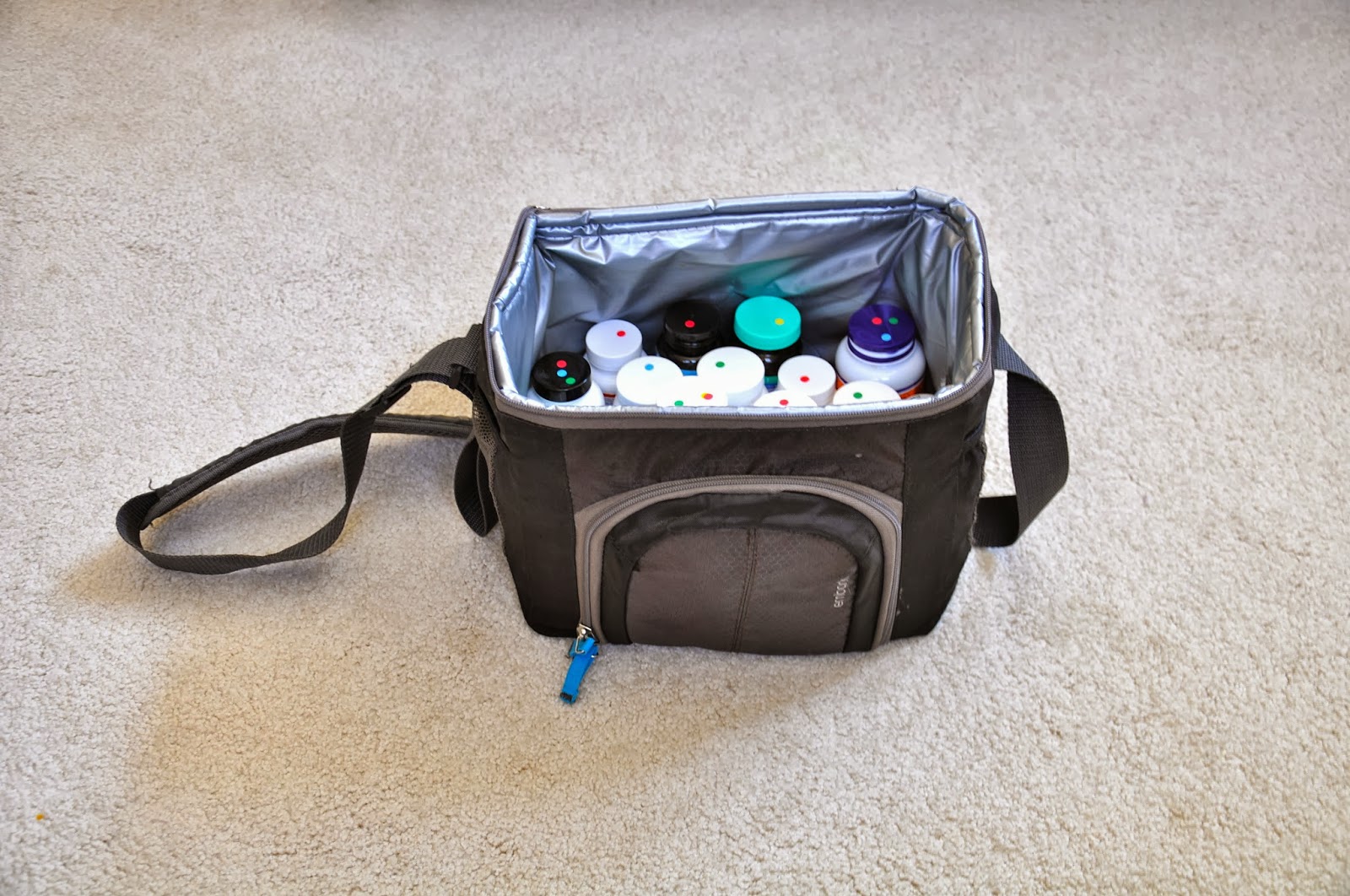
Ahh, the old supplement bin.  Many of us have one.  This is the box that I would never, ever show anyone outside the ME/CFS community, lest they think I'm insane.  They just wouldn't get it.   This box not only contains all those half-used bottles of supplements that, for one reason or another, didn't work out, but also all my in-waiting backup bottles, since buying in bulk saves money.  


The health records binder.  Actually I have another one of these in a closet somewhere with all of my labs and doctor reports.  This one pictured here is just for my nutrigenomics research alone.  Again, I would never show this to an outsider.  


That weird black box in the corner of my bedroom is my portable infrared sauna.  I sit inside it on a folding chair, and my head sticks out a hole in the top (under that flap).  I watch TV or read a book for half an hour and come out looking like a glazed ham. I've written about this many times before here but I'll say again that I credit this sauna for the increase in my baseline that occurred around September/October of 2012.  My body seemed to really need this extra mode of detoxification.


Supplement case:  I'm one of the fortunate ones who is not housebound, so I sometimes find myself out of the house at supplement time (which for me is 3 times a day).  So I keep all my supplements in this soft cooler and just tote the whole damned mini pharmacy around in my car.  It's not sexy, but it works for me.


Speaking of things that are not sexy, I piss on plastic sticks once a week just to keep track of sulfate and body PH.  It's like I'm a pool boy, only much less tan.    


Speaking of pool boys, here is my backyard Jacuzzi that I owned prior to ME/CFS, but had given up since becoming ill because of the affect of the absorbed chemicals on a broken detoxification system. However, thanks to NoPosterGirl, who alerted me to the fact that Dr. Cheney is recommending hydrotherapy as a way for ME/CFS patients to get their all-important lymphatic drainage flowing and as a way of reducing cytokins, I started looking into ways to maintain the spa water quality without chemicals. I discovered a way to do it using ozone and mineral sticks.  So I'm back in the spa, baby.  Like the sauna, it usually leaves me with a feeling very similar to that old after-workout feeling.  Intuitively, you just know it's good for you.


I use the term "paleo" diet just for ease of reference, but my diet really isn't as complicated as all that. Basically I just avoid sugar, grains, casein and a few other things that cause problems for people with candida and ME/CFS.  I try to keep my carb count to under 70 per day, but I only keep track in a very vague sense and don't freak out if I go over.  I could really do an entire post on all the diet-related products I have found, but who wants to read that.  Suffice it to say, I've been finding more and more products at my local organic grocery store that replace old staples like crackers, bread, chocolate & soft drinks. They're hard to find and more expensive than the original, but worth every penny.   


Foam Roller:  When you're severely limited in the amount of physical activity you can do, foam rollers are a good way to get that "stretched out" feeling without the workout.  


Thanks for reading.  I know that we all have different lifestyle changes that work for us, and I always enjoy reading about the ingenuity of the ME/CFS community.  I've read posts from people making their own accommodations that blow away anything in this post.  There was a guy with severe OI/POTS who build a "desk" that allowed him to use his computer while lying flat on his back (hint: the monitor was face down on a glass table).  I've seen jerry-rigged air filtration systems and many other ingenious inventions. Please, if you have other lifestyle changes that you think are worth sharing, I'd love to hear about them.