First, this is the longest I've gone between blog posts, but I've always promised myself that I would not blog just to blog -- that I would only blog when I had something I felt needed to be said.
____________________
August and September were by far my best months since getting ME/CFS. They both averaged at least 3 percentage points higher on my daily health rating chart than my next highest month. That may not sound like much, but it is quite significant.
I'm sure the improvement would have continued into October if it weren't for cold & flu season. Each Fall that I've been ill (this is only my third), a little bit of a "funk" sets in as I realize that I will be battling a continuous string of bugs for the next 5 months. Maybe you've heard of the term "chain smoker" for people who light their next cigarette with the smoldering butt of the last, and so forth. Well, with my weak immune system, I'm basically a "chain sicker" throughout fall and winter. The next sickness rises right out of the ashes of the last. It can be a quite frustrating when that first cold of the season sets in and I know I'm in for a long battle ahead.
_____________________
For many patients, ME/CFS puts their dreams unequivocally out of reach. Bedridden or housebound patients have no choice to but completely reset their goals and expectations. Their lives are profoundly and irrevocably thrown into chaos. To them, I'm sure my problems must seem like a joke. For those of us lucky enough (or early enough) to be only "moderately" affected, ME/CFS works differently. It casts a cloud of uncertainty over nearly ever significant life decision. Every decision that involves future events of any kind, from meeting a friend for lunch, to moving residences, becomes a leap of faith. Contingency plans must be built into everything. Flakiness becomes a part of who we are (and this kills those of us who, prior to ME/CFS, abhorred flakiness.)
My wife and I recently decided to buy a new home. We are in escrow now. The new home is near to our current home, but with a little more room for our recently expanded family. A tad more charm. A little more character.
This was one of the toughest decisions I have had to make, and all because of the unpredictability that ME/CFS presents. Without that hitch, it would have been a "no-brainer."
The new home will, of course, come with a larger mortgage payment. This payment would probably not be affordable on mine or my wife's salary alone. Our combined salaries are necessary.
I know from conversations with veteran patients that many would caution me against taking this risk. Taking this risk assumes that I will be able to continue working at my job, and potentially adds some of that worst-of-all triggers: stress. Undoubtedly, the safe decision would be to stay in the current home, especially since many patients don't experience their first major downturn until around the 3 year mark (and I'm not there yet.) And for a while, this was the plan: to play it safe and stay in the current house until I got a better sense of where my disease progression was headed.
Then the economists began saying that interest rates would likely spike in 2014, and may never be this low again. Suddenly there was a "now or never" urgency, and I weighed the risks again. Looking at it with fresh perspective, I figured the worst that could happen is that I am forced to quit work and we have to move back to a more affordable house. (We are keeping the old house as a rental, so it would be logical to kick the renters out and move back). So, there is a potential fallback plan.
What ultimately changed my mind was when I considered that there is risk in both acting and not acting on a dream. Before, I was only considering the risk of moving and then later regretting it. But when I considered the risk of not moving, only to discover that my health would hold steady or improve just as interest rates climbed, I realized that both options seemed equally risky. So I might as well go for the one that gives me at least a chance at one of my dreams.
If things go wrong and we are forced to downgrade, I will accept that.
Our move date is currently set for late November, assuming escrow goes smoothly. Now the challenge is to accomplish this move without a major crash. I have corresponded with several patients for whom moving was a trigger for relapse. I have already "pushed it" too hard this past weekend, even though I only packed a handful of boxes. I am paying the price now, with a major return of flank pain and PEM. Yet it goes against every instinct I have to pay people to do things that I could do myself (like packing). It may come to that anyway...
Thank you, as always, for reading. If you have any moving advice, I would love to hear it.

Tuesday, October 22, 2013

Monday, September 30, 2013
My Lifestyle Changes in Pictures
Remembering back to the first month after I learned I had ME/CFS, I was reading everything I could get my hands on relating to this disease, trying to figure out exactly what I was dealing with. I don't remember where I read it, but one of the first pieces of advice I ever read stated, "there is no established course of treatment for ME/CFS. A patient must try to live as healthy a life as possible and hope they are one of the lucky ones that recovers." Although it's been two years and probably over 50 treatments since then, I still keep coming back to that simple mantra.
This is not to say that my treatments aren't helping. They are. But other than 1 or 2 prescription drugs, most of my treatments and lifestyle changes simply boil down to "living healthier." In a way, even dietary supplements are just shortcuts to healthier eating. They allow us to ingest more vitamins, minerals and herbs than would be practical through diet.
This post focuses not on supplements or drugs or even "treatments" per se. This post is about all the little lifestyle changes I've made to try to live healthier and give myself the best chance to improve. In some cases, I simply feature items that make life easier with ME/CFS, but offer no health benefit. To the extent that some of these lifestyle changes feature products, let's be clear that I'm not trying to endorse these products. This post is more about not using the old products that these featured products replaced.
_____________________
These first few lifestyle changes all deal with improving sleep. At least two ME/CFS specialists have told me that "it all starts with sleep." They said that real improvement is almost impossible until a patient fixes their sleep disturbances. So, at the outset, I made sleep a major priority. (I should mention that I've known other patients who have tried what I've outlined below and still struggle with sleep issues, so it's clear that results depend on the individual and how severe their ME/CFS is.)
Opaque window shades: Most window coverings let light through, so the nighttime environment in a room still can be fairly illuminated. These window shades are completely opaque and help keep the room pitch black. I never realized how much of a difference a darkened room could make until these shades went in.

In a similar vein to the above, I unplug my bedroom DVR every night and make sure there are no other electronics giving off small amounts of light. You might be surprised - it makes a difference. Some would recommend not even having a TV in my bedroom but, hey, this is still America and I still have my first world addictions.

Body Pillow: I learned of the concept of a body pillow when my wife purchased one during her first pregnancy and then continued to use one even after the pregnancy. I used to tease her about this enormous stuffed "turd" and the fact that it took up half of the bed. Then one morning, about 6 months after I contracted ME/CFS, my wife had already gotten out of bed and I thought, "what the heck." I threw a leg over the body pillow and pulled it close. I knew right then I would never sleep without a body pillow again.
It's such an obvious concept, yet it never occurred to me or most other people. It is very unnatural for your ankle, knee, and elbow to be pressed up against its other corresponding ankle, knee and elbow. The natural position for these body parts is at least shoulder width apart. But for us side-sleepers, that's what happens all night - they come together, which strains our bodies, particularly the back. It was pretty amazing to me what a difference in comfort and sleep quality it made simply by putting a little separation between these body parts with the use of a body pillow. Now it's not uncommon for me to fall asleep in one position and wake up in that same position 7.5 hours later. I realized that a lot of tossing and turning that goes on at night must be due to discomfort from lying too long in a particular sleeping position. Each time you toss and turn, you wake up just a little, so if you can minimize these disturbances, it really seems to improve sleep.
Now my wife is the one who teases me, a grown man who cuddles with a pillow every night. But I usually don't hear the teasing because I'm too busy slumbering.
(Tip: Most body pillows are shaped like a candy cane, with a curve at one end only. If you buy one, get one that is curved at both ends. Your head rests in the top curve and the bottom curve goes between your ankles. This ankle separation is key, in my opinion, and most body pillows don't provide it.)

I sleep with earplugs every night. I started doing this after reading several reports about how low level noises--noises we're not even aware of--interfere with sleep. (e.g. Sleep Foundation) My sleep definitely improved with earplugs.

Natural toothpaste: The original reason I switched to natural toothpaste was because my genetic testing & methylation panel suggested that I should avoid sources of sulfate as a CBS+ individual. But since then, I've come across other good reasons, particularly, the avoidance of fluoride. Note that only some types of Tom's of Maine toothpaste are flouride free. It's such a simple and easy switch to make that I can't believe I didn't do it sooner.


That weird black box in the corner of my bedroom is my portable infrared sauna. I sit inside it on a folding chair, and my head sticks out a hole in the top (under that flap). I watch TV or read a book for half an hour and come out looking like a glazed ham. I've written about this many times before here but I'll say again that I credit this sauna for the increase in my baseline that occurred around September/October of 2012. My body seemed to really need this extra mode of detoxification.


This is not to say that my treatments aren't helping. They are. But other than 1 or 2 prescription drugs, most of my treatments and lifestyle changes simply boil down to "living healthier." In a way, even dietary supplements are just shortcuts to healthier eating. They allow us to ingest more vitamins, minerals and herbs than would be practical through diet.
This post focuses not on supplements or drugs or even "treatments" per se. This post is about all the little lifestyle changes I've made to try to live healthier and give myself the best chance to improve. In some cases, I simply feature items that make life easier with ME/CFS, but offer no health benefit. To the extent that some of these lifestyle changes feature products, let's be clear that I'm not trying to endorse these products. This post is more about not using the old products that these featured products replaced.
_____________________
These first few lifestyle changes all deal with improving sleep. At least two ME/CFS specialists have told me that "it all starts with sleep." They said that real improvement is almost impossible until a patient fixes their sleep disturbances. So, at the outset, I made sleep a major priority. (I should mention that I've known other patients who have tried what I've outlined below and still struggle with sleep issues, so it's clear that results depend on the individual and how severe their ME/CFS is.)
Opaque window shades: Most window coverings let light through, so the nighttime environment in a room still can be fairly illuminated. These window shades are completely opaque and help keep the room pitch black. I never realized how much of a difference a darkened room could make until these shades went in.

In a similar vein to the above, I unplug my bedroom DVR every night and make sure there are no other electronics giving off small amounts of light. You might be surprised - it makes a difference. Some would recommend not even having a TV in my bedroom but, hey, this is still America and I still have my first world addictions.

Body Pillow: I learned of the concept of a body pillow when my wife purchased one during her first pregnancy and then continued to use one even after the pregnancy. I used to tease her about this enormous stuffed "turd" and the fact that it took up half of the bed. Then one morning, about 6 months after I contracted ME/CFS, my wife had already gotten out of bed and I thought, "what the heck." I threw a leg over the body pillow and pulled it close. I knew right then I would never sleep without a body pillow again.
It's such an obvious concept, yet it never occurred to me or most other people. It is very unnatural for your ankle, knee, and elbow to be pressed up against its other corresponding ankle, knee and elbow. The natural position for these body parts is at least shoulder width apart. But for us side-sleepers, that's what happens all night - they come together, which strains our bodies, particularly the back. It was pretty amazing to me what a difference in comfort and sleep quality it made simply by putting a little separation between these body parts with the use of a body pillow. Now it's not uncommon for me to fall asleep in one position and wake up in that same position 7.5 hours later. I realized that a lot of tossing and turning that goes on at night must be due to discomfort from lying too long in a particular sleeping position. Each time you toss and turn, you wake up just a little, so if you can minimize these disturbances, it really seems to improve sleep.
Now my wife is the one who teases me, a grown man who cuddles with a pillow every night. But I usually don't hear the teasing because I'm too busy slumbering.
(Tip: Most body pillows are shaped like a candy cane, with a curve at one end only. If you buy one, get one that is curved at both ends. Your head rests in the top curve and the bottom curve goes between your ankles. This ankle separation is key, in my opinion, and most body pillows don't provide it.)

I sleep with earplugs every night. I started doing this after reading several reports about how low level noises--noises we're not even aware of--interfere with sleep. (e.g. Sleep Foundation) My sleep definitely improved with earplugs.

Natural toothpaste: The original reason I switched to natural toothpaste was because my genetic testing & methylation panel suggested that I should avoid sources of sulfate as a CBS+ individual. But since then, I've come across other good reasons, particularly, the avoidance of fluoride. Note that only some types of Tom's of Maine toothpaste are flouride free. It's such a simple and easy switch to make that I can't believe I didn't do it sooner.

Most of us, I would imagine, have options for filtered water in our kitchens. Maybe it's from the built-in dispenser in the refrigerator, or bottled water from the refrigerator. But what do you do when you're at your bathroom counter brushing your teeth, or taking supplements, or simply getting a drink of water in the middle of the night? A lucky few have whole-home water filtration systems, but I'm not one of them. Instead I found this small filter that attaches to the tap and filters all water that comes through the faucet.

Because going "full hippie" is not an option for me, I still need to use some type of deodorant. But the problem with almost all deodorants is that they contain aluminum. Many natural living enthusiasts will tell you this aluminum is problematic even for healthy people, but according to Dr. Yasko, ME/CFS patients have particular trouble eliminating aluminum from the system due to our broken detoxification mechanisms. All that aluminium just builds up in our systems and then leads to cascade of other problems, especially in the gut, according to Yasko. Yasko is big on detox of all metals but aluminum in particular, so this switch was a no-brainer for me.
But, I recently read a report that even Tom's of Maine contains an ingredient, propylene glycol, that is linked to cancer and developmental issues. So I'm looking for a new alternative. I refuse to resort to patchouli oil!

Ahh, the old supplement bin. Many of us have one. This is the box that I would never, ever show anyone outside the ME/CFS community, lest they think I'm insane. They just wouldn't get it. This box not only contains all those half-used bottles of supplements that, for one reason or another, didn't work out, but also all my in-waiting backup bottles, since buying in bulk saves money.

The health records binder. Actually I have another one of these in a closet somewhere with all of my labs and doctor reports. This one pictured here is just for my nutrigenomics research alone. Again, I would never show this to an outsider.

That weird black box in the corner of my bedroom is my portable infrared sauna. I sit inside it on a folding chair, and my head sticks out a hole in the top (under that flap). I watch TV or read a book for half an hour and come out looking like a glazed ham. I've written about this many times before here but I'll say again that I credit this sauna for the increase in my baseline that occurred around September/October of 2012. My body seemed to really need this extra mode of detoxification.

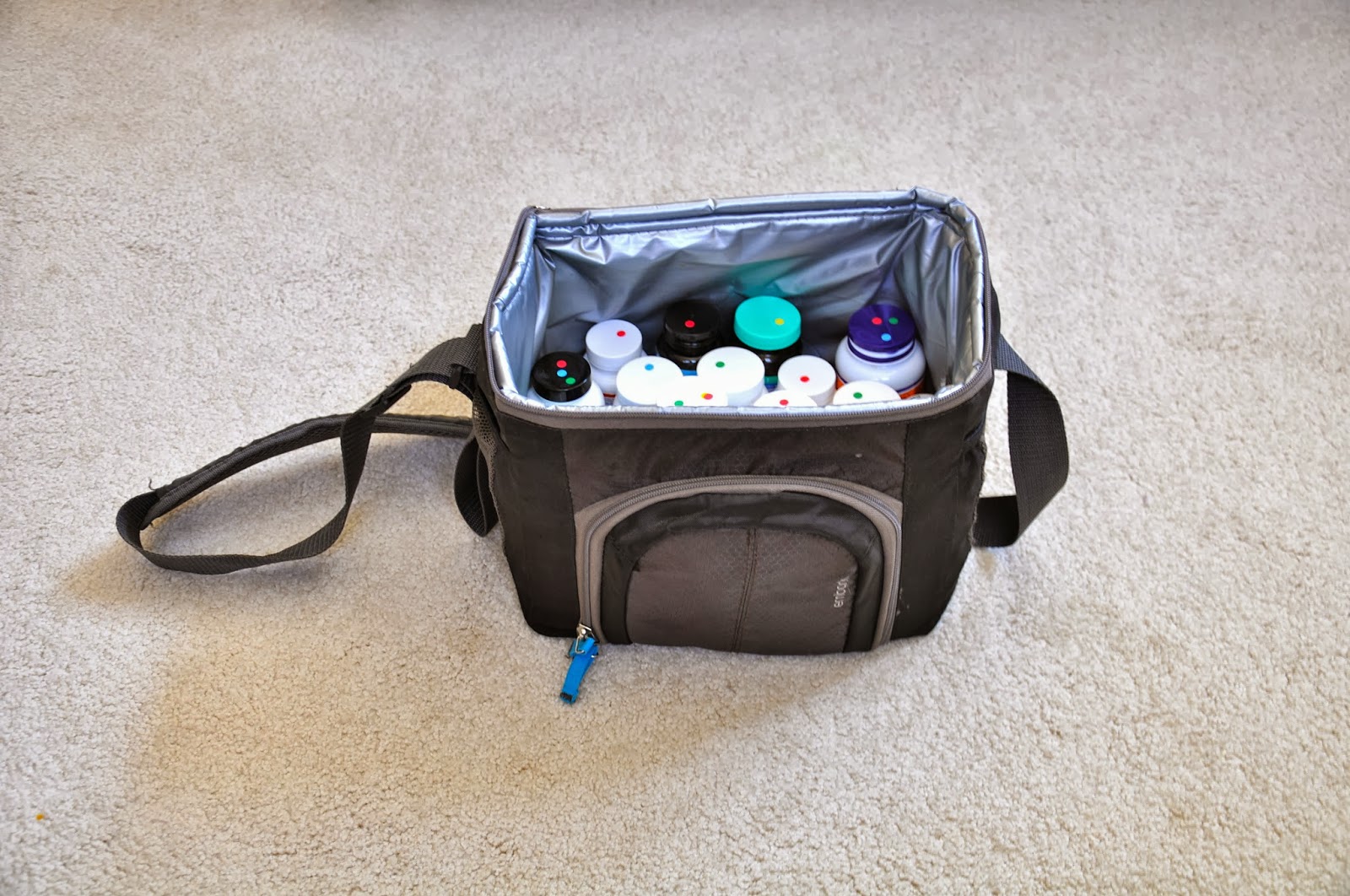
Supplement case: I'm one of the fortunate ones who is not housebound, so I sometimes find myself out of the house at supplement time (which for me is 3 times a day). So I keep all my supplements in this soft cooler and just tote the whole damned mini pharmacy around in my car. It's not sexy, but it works for me.
Speaking of things that are not sexy, I piss on plastic sticks once a week just to keep track of sulfate and body PH. It's like I'm a pool boy, only much less tan.

Speaking of pool boys, here is my backyard Jacuzzi that I owned prior to ME/CFS, but had given up since becoming ill because of the affect of the absorbed chemicals on a broken detoxification system. However, thanks to NoPosterGirl, who alerted me to the fact that Dr. Cheney is recommending hydrotherapy as a way for ME/CFS patients to get their all-important lymphatic drainage flowing and as a way of reducing cytokins, I started looking into ways to maintain the spa water quality without chemicals. I discovered a way to do it using ozone and mineral sticks. So I'm back in the spa, baby. Like the sauna, it usually leaves me with a feeling very similar to that old after-workout feeling. Intuitively, you just know it's good for you.

I use the term "paleo" diet just for ease of reference, but my diet really isn't as complicated as all that. Basically I just avoid sugar, grains, casein and a few other things that cause problems for people with candida and ME/CFS. I try to keep my carb count to under 70 per day, but I only keep track in a very vague sense and don't freak out if I go over. I could really do an entire post on all the diet-related products I have found, but who wants to read that. Suffice it to say, I've been finding more and more products at my local organic grocery store that replace old staples like crackers, bread, chocolate & soft drinks. They're hard to find and more expensive than the original, but worth every penny.

Foam Roller: When you're severely limited in the amount of physical activity you can do, foam rollers are a good way to get that "stretched out" feeling without the workout.

Thanks for reading. I know that we all have different lifestyle changes that work for us, and I always enjoy reading about the ingenuity of the ME/CFS community. I've read posts from people making their own accommodations that blow away anything in this post. There was a guy with severe OI/POTS who build a "desk" that allowed him to use his computer while lying flat on his back (hint: the monitor was face down on a glass table). I've seen jerry-rigged air filtration systems and many other ingenious inventions. Please, if you have other lifestyle changes that you think are worth sharing, I'd love to hear about them.
Wednesday, September 25, 2013
An open letter by top ME/CFS doctors to HHS
By now everyone in the ME/CFS community (in America anyway) is familiar with the controversy over the U.S. Department of Health and Human Services (HHS) hiring an outside contractor to develop a new definition of ME/CFS. If you've somehow missed everything that's occurred on this front in the past month, here's the 50 peso version:
The letter is republished here on ProHealth.
HHS announced that they were going hire an outside contractor to, among other things, redefine ME/CFS and create diagnostic criteria. The leading candidate was a company called the Institute of Medicine (IOM). IOM had previously been hired to conduct similar work related to Gulf War Syndrome and, by most accounts, completely botched the job, leading to much frustration by GWS sufferers. Knowing this, the ME/CFS community launched a grass roots email campaign to stop the IOM contract. Not long after, HHS announced that they cancelled their plans to hire IOM. The ME/CFS community breathed a sigh of relief. Several days later, HHS reversed course and hired IOM anyway.Now a group of leading ME/CFS doctors and researchers have published an open letter to the director of HHS imploring her to reconsider the entire project and, particularly, to adopt the Canadian Consensus Criteria (CCC) definition of ME/CFS. The letter is direct, forceful and is cosigned by all the big names. It will be interesting to see if HHS has the guts to ignore this (but history tells us they will).
The letter is republished here on ProHealth.
Wednesday, September 11, 2013
New Study Results on Viral Infection in ME/CFS Making the Rounds
These new study results, as reported in a speech by Dr. Ian Lipkin, are making the news rounds in the ME/CFS world this week.
These findings are supposedly a big deal because the study was the largest of its kind and used more sophisticated virus hunting techniques than ever before. And, the study was a collaboration among a several big name ME/CFS researchers.
Here's a pretty eye-catching quote from the article: "With two large sample sets turning up negative in the lab of one of most acclaimed virus hunters on the planet, it's probably safe to say that the hunt for an infectious agent in the blood of people with ME/CFS is over."
Wait, what?! If you believe that (and how do you argue with Lipkin?) then all those blood tests we've had with supposedly elevated IgG titers for EBV, HHV-6, and CMV were meaningless. These antibody tests may have suggested reactivated infections, but that was only hypothesis. This new study apparently looked for the actual presence of the viruses (which is more reliable than antibody testing) and found nothing.
Then I wondered, how do you explain why Valycte and antivirals helps so many patients? It looks like the answer might be in the part of the article where Lipkin states that they still believe an infection is the likely culprit, but it's just not present in the blood. It's likely to be a localized infection, such as an infection in the lining of the gut (as Dr. C has always maintained), or in the Vagus nerve.
To me, the results are both exciting and frustrating. I think all of our first choices would have been that the study actually found the culprit. But barring that, it feels very significant that they allegedly "ruled out" what has been a major focus of research for many years. This will hopefully allow researchers narrow in on other more fruitful areas of research going forward.
Update on Nutrigenomics Treatment
Review
Back in March of this year, I began a nutrigenomics plan to address the defects in the "methylation cycle" that appeared on genetic testing. The process started with getting genetic testing from 23andME for $99, followed by running the results through a website called Genetic Genie, which analyzes only those specific genes that have been identified as affecting the methylation cycle - one of the body's detoxification systems that has been shown to be defective in ME/CFS patients. Then, after reading the book and online forums of Dr. Yasko, I implemented a "nutrigenomics" plan to try to address my specific methylation cycle defects.
In the intervening 6 months, I have submitted a couple of urine and hair sample tests, which can be submitted via mail through Dr. Yasko's company. The point of these tests is to further refine which supplements to take and in what amounts to address methylation issues. In addition, there are a couple of home urine tests that I conduct on a weekly basis to track progress (more on that below).
Update
These methylation supplements have taken longer to implement that I predicted at the outset. I would have thought I'd have implemented all the supplements within a couple of months of when I started, but as it's turning out, I'm still in the middle of the process six months later. The process is supposed to unfold in at least 3 steps. First, you change your diet and add a series of "basic support supplements" -- these are supplements like multivitamins, magnesium, zinc, Vitamin-D, and different types of antioxidants. I was done with that step by April and didn't notice any difference in how I felt, but didn't expect to either.
Then before the next step, you're supposed to address "first priority" genetic mutations, if you have them. I have one of them -- a so-called "CBS mutation," which leads to an excess build-up of sulfer and ammonia in the body. So this requires reducing protein in the diet (which I only did very slightly) and taking a couple of supplements that flush the body of excess sulpher and ammonia. I could track the progress of this with home urine sulfate tests, which eventually showed when I was ready to move on.
Finally in about July, I was ready to move on to addressing the actual methylation cycle defects. This step is broken down into two phases. Dr. Yasko describes that the body has two ways of making the powerful antioxidant glutathione -- which is the end result of a functioning methylation cycle. The first is a "short cut" chemical reaction, and the second is the "long route" chemical reaction. If the methylation cycle is working properly, both routes are producing glutathione. Dr. Yasko recommends that patients address the short cut first.
I had the short cut supplements implemented by about early July. These supplements include an phospholipid complex called, for short, "PS/pc/pe," and DHA (which I was already taking). An optional third supplement was an RNA Supplement called "Methylation Support RNA." This supplement is expensive and there is some controversy about the efficacy of Yasko's RNA supplements, so although I tried it, I didn't renew when the bottle ran out in 3 weeks.
By late July, I experienced a noticeable uptick in my health. My daily health rating for August was the highest month yet by more than a 3% increase, which on my health chart system is a huge increase. Previous increases were typically small fractions of 1%. So I'm wondering now if this PS/pc/pe complex was a key component of this improvement. Of course, one month of improvement could be an anomaly, so we'll have to wait and see.
In the mean time, I've started adding long route methylation supplements, namely the hydroxy- and adenosyl- forms of Vitamin B12, but there are other supplements to be added so it will be a while before I know these "long route" methylation supplements will help.
Friday, August 30, 2013
How big a role do mycotoxins play in ME/CFS?
The only explanation for the etiology of ME/CFS that makes sense to me is that it is a disease of complex origin, with multiple contributing factors. I simply don't believe that if ME/CFS had only one cause (say, a virus) that its origins would have eluded so many dedicated researchers for this long. I believe that, like autism, multiple sclerosis, autoimmune diseases in general, and other diseases of inflammation, we're dealing with a complex nexus of environmental, pathogenetic, genetic, dietary, vaccine-related, and possibly stress-related factors.
To my mind, this multiple causation theory is the only theory that explains why ME/CFS and other "chronic illnesses of unknown origin" aren't more common than they are. If it's environmental, then why don't all members of a moldy household always get sick? If it's solely genetic, again, why haven't we seen a clear lineage of ME/CFS being passed down in affected families? (Sometimes we do, sometimes we don't). If it's a pathogen, why don't all people with high EBV and CMV titers get ME/CFS? Why don't we all have borrellia?
I personally don't believe there's some mystery pathogen out there that we haven't identified yet (ala XMRV). I believe if it existed, it most likely would have been found by now. One even hears the theory that ME/CFS tends to hit "type A" personalities more often, but if that's true, I know quite a few people who are much bigger "stress cases" than me and they're doing just fine. Vaccines? Well, you know where I'm going with that....
Instead, I believe that when they finally solve ME/CFS, they'll discover that us PWMEs are the unlucky few who suffered the chance convergence of triple or quadruple insults to our systems, often all within a short period of time. If you read enough PWMEs' "origin stories" they almost all describe a piling on of various factors: a stressful event, then a viral infection, followed by a vaccine, etc.
By the way, take a moment to think about what order of importance you would have placed these five commonly suspected factors in ME/CFS. My order, from most significant to least would probably be:
1. Pathogens
2. Genes
3. Vaccines
4. Dietary
5. Environmental
6. Stress-related (I question whether this even belongs on the list)
(Have I left anything major out?)
I couldn't even tell you why I've ordered the list in this way. It's the gestalt product of hundreds, maybe thousands, of articles, blogs and forum posts that have washed over me and are now sloshing around in my head. My ordering is likely to shuffle at any time based on the latest CFS Facebook link, or some fad theory making the rounds.
Now consider that the path to ME/CFS is likely different for each patient. Maybe Patient A's path to ME/CFS was 80% environmental, and he was then pushed to the brink (another 19%) by pathogens and a little stress was the coup de grace.
And Maybe Patient B has a homogenous MTHFR genetic polymorphism, which gets her 50% there, and a vaccine at an inopportune time finishes the job. The different pathways to ME/CFS could be endless.
(Side note: with these complexities, not to mention the complexities of our ever evolving symptoms is this "multi-system" disorder, I believe the best chance we have to get to the bottom of ME/CFS is through compiling vast data banks of detailed patient histories and then applying complex data analysis techniques. This, of course, depends on as many of us as possible participating in patient databanks like the Open Medicine Institute's, discussed in this post)
____________________
All of that was my prelude to saying that I've been rethinking the role of environmental issues, particularly mycotoxins (mold-related toxins). For a friend of mine, this has been the key to his improvement in recent years. He had to go to great lengths to enact this improvement, even moving to a city with drier, cleaner air, and then renovating his home to remove mycotoxins and environmental chemicals. It hasn't cured him, but he has done a remarkable 180 and can do things that I can't even consider right now. And more importantly, he has control over his crashes, for the most part. If he crashes, he knows why and he knows what he can do about it (get out of the triggering environment.)
That same friend recently posted this article that has me rethinking the role that environmental factors might play in my illness. I think all patients should read it and consider whether mold is an issue for them (if you haven't already): http://www.bulletproofexec.com/how-your-house-can-make-you-weak/
As I told my friend, I have always intended to investigate mold issues as a factor in my illness, but it becomes hectic when you're chasing so many different possibilities and treatments. Even high priority questions like mold could take me years to get around to at my current rate. There's only so much I can investigate at once. But I'm now moving "mold" up higher on my list of priorities.
__________________
For those like me that haven't had a chance to consider mold very much, here are a few other sources to get you started:
One thing that gives me pause: When I search the Internet for studies or articles on the role of mold exposure in ME/CFS, all results point back to this one study linked above. I'd like to see it replicated and peer reviewed. (This is when the progress of ME/CFS research becomes frustratingly slow...)
To my mind, this multiple causation theory is the only theory that explains why ME/CFS and other "chronic illnesses of unknown origin" aren't more common than they are. If it's environmental, then why don't all members of a moldy household always get sick? If it's solely genetic, again, why haven't we seen a clear lineage of ME/CFS being passed down in affected families? (Sometimes we do, sometimes we don't). If it's a pathogen, why don't all people with high EBV and CMV titers get ME/CFS? Why don't we all have borrellia?
I personally don't believe there's some mystery pathogen out there that we haven't identified yet (ala XMRV). I believe if it existed, it most likely would have been found by now. One even hears the theory that ME/CFS tends to hit "type A" personalities more often, but if that's true, I know quite a few people who are much bigger "stress cases" than me and they're doing just fine. Vaccines? Well, you know where I'm going with that....
Instead, I believe that when they finally solve ME/CFS, they'll discover that us PWMEs are the unlucky few who suffered the chance convergence of triple or quadruple insults to our systems, often all within a short period of time. If you read enough PWMEs' "origin stories" they almost all describe a piling on of various factors: a stressful event, then a viral infection, followed by a vaccine, etc.
By the way, take a moment to think about what order of importance you would have placed these five commonly suspected factors in ME/CFS. My order, from most significant to least would probably be:
1. Pathogens
2. Genes
3. Vaccines
4. Dietary
5. Environmental
6. Stress-related (I question whether this even belongs on the list)
(Have I left anything major out?)
I couldn't even tell you why I've ordered the list in this way. It's the gestalt product of hundreds, maybe thousands, of articles, blogs and forum posts that have washed over me and are now sloshing around in my head. My ordering is likely to shuffle at any time based on the latest CFS Facebook link, or some fad theory making the rounds.
Now consider that the path to ME/CFS is likely different for each patient. Maybe Patient A's path to ME/CFS was 80% environmental, and he was then pushed to the brink (another 19%) by pathogens and a little stress was the coup de grace.
And Maybe Patient B has a homogenous MTHFR genetic polymorphism, which gets her 50% there, and a vaccine at an inopportune time finishes the job. The different pathways to ME/CFS could be endless.
(Side note: with these complexities, not to mention the complexities of our ever evolving symptoms is this "multi-system" disorder, I believe the best chance we have to get to the bottom of ME/CFS is through compiling vast data banks of detailed patient histories and then applying complex data analysis techniques. This, of course, depends on as many of us as possible participating in patient databanks like the Open Medicine Institute's, discussed in this post)
____________________
All of that was my prelude to saying that I've been rethinking the role of environmental issues, particularly mycotoxins (mold-related toxins). For a friend of mine, this has been the key to his improvement in recent years. He had to go to great lengths to enact this improvement, even moving to a city with drier, cleaner air, and then renovating his home to remove mycotoxins and environmental chemicals. It hasn't cured him, but he has done a remarkable 180 and can do things that I can't even consider right now. And more importantly, he has control over his crashes, for the most part. If he crashes, he knows why and he knows what he can do about it (get out of the triggering environment.)
That same friend recently posted this article that has me rethinking the role that environmental factors might play in my illness. I think all patients should read it and consider whether mold is an issue for them (if you haven't already): http://www.bulletproofexec.com/how-your-house-can-make-you-weak/
As I told my friend, I have always intended to investigate mold issues as a factor in my illness, but it becomes hectic when you're chasing so many different possibilities and treatments. Even high priority questions like mold could take me years to get around to at my current rate. There's only so much I can investigate at once. But I'm now moving "mold" up higher on my list of priorities.
__________________
For those like me that haven't had a chance to consider mold very much, here are a few other sources to get you started:
- Mycotoxins are the main focus of one of ME/CFS's more well-know physicians: Dr. Shoemaker. I admit, I haven't even had the chance to learn the first thing about Shoemaker's theories.
- Detection of Mycotoxins in Patients with ME/CFS (a study finding that "Urine specimens from 104 of 112 patients (93%) were positive for at least one mycotoxin..." Apparently ZERO of the 55 controls tested positive.
- And a post from Health Rising, discussing the same study and putting it in context.
One thing that gives me pause: When I search the Internet for studies or articles on the role of mold exposure in ME/CFS, all results point back to this one study linked above. I'd like to see it replicated and peer reviewed. (This is when the progress of ME/CFS research becomes frustratingly slow...)
Wednesday, August 28, 2013
So a man walks into a gym...
Yesterday I stepped foot in a gymnasium for the first time since before I became ill.
For the first year or so that I had ME/CFS, I didn't do any exercise. I didn't feel up to it all, and if I tried, I crashed. My resting heart rate at the time was already in the 100s, so it felt like any exercise would make my heart explode. And I won't even get into the problems with POTS and exercise.
Then with a little improvement, I started doing some Tai Chi, which is pretty much the most mellow form of exercise you can possibly do. I hesitate to even call it exercise.
After a while, it became clear that I could handle Tai Chi with no problem, and I began to feel the urge for that old after-exercise feeling. You know, that feeling where you're relaxed and that your blood and lymphatic drainage system is flowing more freely. So as my treatments progressed and I started to feel better, I moved on to yoga. First I started with my wife's low-key prenatal yoga videos. Then I moved on to regular yoga videos and to doing sequences of "asanas" that I remembered from my days of taking yoga classes.
During this period, I also started doing far infrared sauna sessions every 2 or 3 days, which for some reason, always left me with a feeling like I had exercised. Truely, the feeling is almost identical, and I even record my sauna sessions in the same column as my so-called "workouts" on my health charts. I believe that the same principles are at play: blood flow and lymphatic drainage.
In the last few months, I have graduated to lifting weights at home, trying to gain back some of the over 35 pounds in muscle mass that I lost when I got ME/CFS (OK, some of it was fat!). I don't want all of it back, but half would be nice. My goal is to get up to about 195-200 lbs (88-90kgs), which is what the Body Mass Index says is ideal for my height and build. I am at about 194 lbs now, so I'm close.
I lift smaller weights than I lifted before ME/CFS, as the goal here is not to build showy "beach muscles" but rather to improve my health and well being. Excess build up of lactic acid would only be counterproductive to my goals.
Yesterday, I took the next step and actually went back into a gym. Although I have a nice collection of different sized dumbells at home, my home workout options are limited when it comes to leg exercises, and I definitely don't want to be one of those people who has solid upper body mass, balanced on top of toothpick legs.
So I cautiously banged out (oxymoron?) a few sets of leg presses, calf presses, and leg raises, and then I rode a reclining stationary bike for ten minutes. (The reclining bike is better for keeping your heart rate in check. Most gyms have at least one). The whole time I wore my heart rate monitor and made sure to keep my heart rate under my estimated AT of about 100-115. I found that I could more or less make it to hover just below my AT and stay there if I carefully monitored it and adjusted my pace accordingly.
Let me be clear about one thing, I'm not suggesting that these exercises are responsible for my improvements. The improvements came first, likely from treatments, and the increased levels of exercise followed.
But the whole point of this post is this: Damn it felt good to be back in a gym. That feeling that I've had for the last two years, that I'm an alien in the world of the physically active, melted away for an hour. Simply being around the hustle and bustle of a gym, the people running around in their slick workout outfits, carrying towels, feeling good, wiping down equipment--it felt right. Everyone's iPoded up, struttin' their stuff, in their own worlds. (It's quite comical, actually.) I even welcomed that gym-y smell of stale sweat.
So far today I feel OK, but I wouldn't expect a PEM crash until tomorrow if it comes. If this experiment works out, I plan to make gym trips a once-a-week thing. I'm always wary of pushing too hard and relapsing, but at the same time, I need to find out exactly what my limits are as they change over time. As the respected Dr. Klimas has said, doing as much "exercise" as we can do without crashing (and that's the key), however much or how little that may be, could be a key factor in reversing the dysfunctional gene expression that we experience. This is a controversial opinion, as many patients report being made worse by even the slightest of exercises, but in my case, I think I'll continue on my path and proceed cautiously.
For the first year or so that I had ME/CFS, I didn't do any exercise. I didn't feel up to it all, and if I tried, I crashed. My resting heart rate at the time was already in the 100s, so it felt like any exercise would make my heart explode. And I won't even get into the problems with POTS and exercise.
Then with a little improvement, I started doing some Tai Chi, which is pretty much the most mellow form of exercise you can possibly do. I hesitate to even call it exercise.
After a while, it became clear that I could handle Tai Chi with no problem, and I began to feel the urge for that old after-exercise feeling. You know, that feeling where you're relaxed and that your blood and lymphatic drainage system is flowing more freely. So as my treatments progressed and I started to feel better, I moved on to yoga. First I started with my wife's low-key prenatal yoga videos. Then I moved on to regular yoga videos and to doing sequences of "asanas" that I remembered from my days of taking yoga classes.
During this period, I also started doing far infrared sauna sessions every 2 or 3 days, which for some reason, always left me with a feeling like I had exercised. Truely, the feeling is almost identical, and I even record my sauna sessions in the same column as my so-called "workouts" on my health charts. I believe that the same principles are at play: blood flow and lymphatic drainage.
In the last few months, I have graduated to lifting weights at home, trying to gain back some of the over 35 pounds in muscle mass that I lost when I got ME/CFS (OK, some of it was fat!). I don't want all of it back, but half would be nice. My goal is to get up to about 195-200 lbs (88-90kgs), which is what the Body Mass Index says is ideal for my height and build. I am at about 194 lbs now, so I'm close.
I lift smaller weights than I lifted before ME/CFS, as the goal here is not to build showy "beach muscles" but rather to improve my health and well being. Excess build up of lactic acid would only be counterproductive to my goals.
Yesterday, I took the next step and actually went back into a gym. Although I have a nice collection of different sized dumbells at home, my home workout options are limited when it comes to leg exercises, and I definitely don't want to be one of those people who has solid upper body mass, balanced on top of toothpick legs.
 |
| Credit: WeKnowMemes |
Let me be clear about one thing, I'm not suggesting that these exercises are responsible for my improvements. The improvements came first, likely from treatments, and the increased levels of exercise followed.
But the whole point of this post is this: Damn it felt good to be back in a gym. That feeling that I've had for the last two years, that I'm an alien in the world of the physically active, melted away for an hour. Simply being around the hustle and bustle of a gym, the people running around in their slick workout outfits, carrying towels, feeling good, wiping down equipment--it felt right. Everyone's iPoded up, struttin' their stuff, in their own worlds. (It's quite comical, actually.) I even welcomed that gym-y smell of stale sweat.
So far today I feel OK, but I wouldn't expect a PEM crash until tomorrow if it comes. If this experiment works out, I plan to make gym trips a once-a-week thing. I'm always wary of pushing too hard and relapsing, but at the same time, I need to find out exactly what my limits are as they change over time. As the respected Dr. Klimas has said, doing as much "exercise" as we can do without crashing (and that's the key), however much or how little that may be, could be a key factor in reversing the dysfunctional gene expression that we experience. This is a controversial opinion, as many patients report being made worse by even the slightest of exercises, but in my case, I think I'll continue on my path and proceed cautiously.
Subscribe to:
Posts (Atom)